- Cleaning 365
Construction and renovation crews build the space, but they don’t clean it. That job falls to a specialized process called post-construction cleaning, and skipping it (or treating it like a regular house clean) is one of the most common mistakes property owners and contractors make before handover. For an ongoing space, this kind of intensive reset is closer to deep cleaning services than routine janitorial work, though the two solve different problems, covered later in this guide.
This guide breaks down what post-construction cleaning actually involves, why it’s different from a standard clean, the exact stages professionals follow, and how to get your space genuinely move-in ready, whether it’s a Mississauga office fit-out or a residential renovation anywhere in Canada. Since a post-construction clean is a one-time need tied to a specific project rather than a standing contract, it’s typically scoped and priced as project-based commercial cleaning rather than folded into a recurring schedule.
What Is Post-Construction Cleaning?
Post-construction cleaning is a specialized service that removes construction dust, debris, and material residue from a newly built or renovated space so it’s safe and ready to occupy. It’s a distinct discipline from janitorial or residential cleaning because it deals with hazards and mess that ordinary cleaning tools can’t handle.
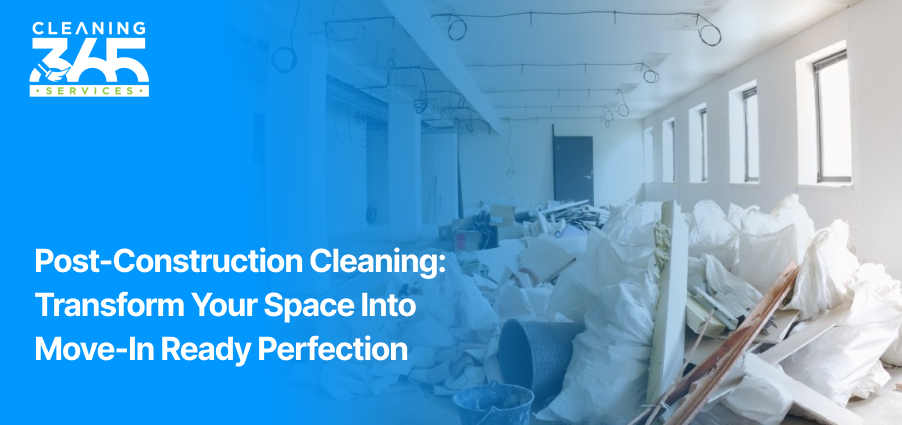
A construction site doesn’t just look messy. It’s covered in fine gypsum and drywall dust, paint overspray, adhesive residue, and sometimes sharp debris like nails, screws, and glass shards. Post-construction cleaning (also called post-renovation cleaning, final construction cleaning, or a builders clean) systematically removes all of it, working from the ceiling down to the floor so nothing gets missed twice.
It typically covers:
- Interior surfaces: walls, ceilings, light fixtures, vents, baseboards
- Floors: sweeping, HEPA vacuuming, mopping, and protective coating removal
- Windows and glass: sticker, glue, and paint overspray removal
- Kitchens and bathrooms: cabinetry, countertops, fixtures, tile and grout
- Exterior touch points: entryways, walkways, and construction signage removal, which often overlaps with Professional lawn yard snow cleaning services when construction debris has spread into surrounding grounds or a winter project has left snow and ice tracked across the site
Why Regular Cleaning Isn’t Enough
Standard household or office cleaning products and vacuums aren’t built to handle construction dust, and using them can actually make the problem worse. The core issue is particle size: construction dust is far finer than everyday dirt.
Drywall sanding, in particular, generates airborne particles fine enough to pass through a standard vacuum filter and resettle on every surface within hours. Occupational health researchers classify fine particulate matter under 2.5 microns (PM2.5) as a genuine respiratory concern, since particles at this size can penetrate deep into the lungs rather than being filtered out by the body’s upper airway. A U.S. National Institute for Occupational Safety and Health evaluation also found that drywall sanders were exposed to airborne dust levels as high as ten times the OSHA permissible exposure limit when proper controls weren’t in place.
That’s why professional crews use different equipment entirely:
| Tool/Technique | Purpose | Why Standard Tools Fail |
|---|---|---|
| Industrial HEPA vacuums | Capture ultrafine dust without recirculating it into the air | Household vacuums push fine particles back into the room |
| Specialized solvents | Cut through drywall mud, silicone, and adhesive overspray | Standard cleaners can smear or damage new surfaces |
| Top-to-bottom phasing | Prevents re-dirtying finished areas | Random-order cleaning means redoing work |
| Microfiber cloths | Trap dust instead of pushing it around | Paper towels and standard rags spread dust |
If your office or facility is weighing how often deep cleans like this should happen versus routine upkeep, our guide to daily vs. weekly cleaning schedules for offices covers how to plan a maintenance calendar after the post-construction clean is done.
The Stages of Post-Construction Cleaning
Post-construction cleaning happens in stages, rough cleaning, light (or detailed) cleaning, and final cleaning, with each stage building on the last so no area is cleaned only once when it needed two or three passes. Skipping a stage is the most common reason a “finished” space still looks unfinished. A fourth pass, a touch-up clean scheduled close to move-in day, is worth adding on top of these three, since fine dust that settled during final cleaning can resurface before occupants actually arrive.
Stage 1: Rough Cleaning
Rough cleaning happens immediately after construction wraps and focuses on removing the bulk of the mess: leftover materials, packaging, large debris, and heavy dust layers.
Crews use industrial brooms, heavy-duty vacuums, and shovels to clear the site down to a workable surface. This stage isn’t about polish, it’s about making the space safe enough to walk through and clean in detail.
Stage 2: Light Cleaning (Detailed Surface Cleaning)
Light cleaning targets the dust and residue that rough cleaning leaves behind, working through walls, windows, fixtures, and floors with HEPA vacuums and microfiber cloths.
This is where surfaces start to actually look clean rather than just cleared. Vents and HVAC returns get special attention here, since leftover dust in the ductwork will simply resettle on clean surfaces within days if it’s not addressed.
Stage 3: Final Cleaning (Precision Finishing)
Final cleaning is the detail pass completed just before handover, polishing fixtures, removing paint and adhesive spots from glass, wiping baseboards, and doing a full walkthrough to catch anything missed.
This stage is what separates a “cleaned” space from a genuinely move-in ready one. It’s also where most quality complaints originate if it’s rushed, since small residues (a paint fleck on a window, dust in a light fixture) are exactly what a new occupant notices first.
Stage 4: Touch-Up Cleaning Before Occupancy
Fine drywall dust can continue settling out of the air for several days after sanding, even after a thorough final clean. A touch-up pass scheduled within a day or two of actual move-in catches this resettled dust before anyone occupies the space, which matters most on projects where the final clean happens more than a couple of days before handover.
Comparing the Stages
| Phase | Main Goal | When It Happens | Key Tools |
|---|---|---|---|
| Rough Cleaning | Remove large debris and bulk dust | Immediately after construction | Industrial brooms, heavy-duty vacuums, shovels |
| Light Cleaning | Detailed surface and dust removal | Between rough and final cleaning | HEPA vacuums, microfiber cloths, general cleaning agents |
| Final Cleaning | Precision finishing and inspection-ready polish | Just before handover | Specialized cleaners, detailing tools, inspection checklist |
| Touch-Up Cleaning | Catch dust that resettles after final cleaning | Within a day or two of move-in | HEPA vacuums, microfiber cloths |
Room-by-Room Post-Construction Cleaning Checklist
Every room in a newly built or renovated space needs a slightly different approach, since kitchens, bathrooms, and living areas each collect different types of residue. Here’s what a thorough clean covers room by room.
Kitchen
- Interior and exterior of all cabinetry wiped down
- Stainless steel appliances and fixtures polished
- Countertops cleaned and checked for adhesive or sealant residue
- Sink, faucet, and backsplash detailed
Bathrooms
- Tile and grout scrubbed
- Tubs, showers, and sinks sanitized
- Mirrors and glass polished streak-free
- Fixtures and hardware wiped and checked for construction residue
Living Areas and Bedrooms
- Hard surfaces and baseboards wiped down
- Carpets HEPA-vacuumed to remove embedded dust
- Closet shelving and interiors dusted
- Light switches, outlets, and vents cleaned
Windows and Doors
- Stickers, tape residue, and glue safely removed from glass
- Sills, tracks, and frames wiped clean
- Door hardware polished and checked for paint spatter
If your space has carpeting that took on heavy construction dust, it’s worth pairing this checklist with a proper deep extraction. See our overview of commercial carpet cleaning machines in Canada for what actually lifts embedded dust versus what just moves it around.
Why Post-Construction Cleaning Is Worth the Investment
A professional post-construction clean pays for itself by protecting the safety of occupants, the condition of new surfaces, and the impression the finished space makes. Here’s what’s actually at stake if it’s skipped or rushed.
- Safety. Nails, glass fragments, and fine dust left on-site are genuine hazards, especially for residential projects where children will be in the space.
- Surface protection. Leftover adhesive, paint overspray, or grit can scratch new flooring and fixtures if it isn’t removed with the right technique and products.
- Time efficiency. A dedicated crew clears a site far faster than internal staff working it in between other tasks, which matters when handover dates are fixed.
- First impressions. For contractors and property managers, a spotless handover is often the last thing a client remembers about the whole project.
This is also part of why Cleaning services expands scalable commercial cleaning solutions across canada, since post-construction demand tends to follow wherever new commercial development is happening, not just the markets a provider already has staff in.
Common Challenges in Post-Construction Cleaning
The biggest obstacles in post-construction cleaning are persistent fine dust, stubborn residues like paint and adhesive, tight handover deadlines, and coordinating cleaning crews around other trades still finishing work on-site.
- Persistent dust. Fine drywall dust resettles for days after sanding, which is why HVAC vents and returns need direct attention, not just visible surfaces, and why a touch-up pass close to move-in matters as much as the final clean itself.
- Stubborn residue. Paint splatter and adhesive overspray can damage a surface if scraped with the wrong tool, so crews need product knowledge, not just elbow grease.
- Tight deadlines. Construction schedules rarely leave much buffer, so cleaning has to be planned into the project timeline, not bolted on at the end.
- Trade coordination. Cleaning crews often work around electricians, painters, or flooring installers still finishing punch-list items, which requires scheduling flexibility.
How Post-Construction Cleaning Works: Step-by-Step
- Initial inspection and planning. Walk the site, identify priority areas and hazards, and build a cleaning plan that coordinates with any trades still on-site.
- Rough cleaning. Clear large debris, packaging, and leftover materials with industrial vacuums and brooms.
- Light cleaning. Dust and wipe every surface, walls, windows, fixtures, floors, using HEPA vacuums and microfiber tools.
- Final cleaning. Do a detail pass on every room, removing remaining residue and polishing surfaces for handover.
- Touch-up cleaning. Schedule a final dust pass within a day or two of move-in to catch anything that resettled after the final clean.
- Final inspection. Walk the space against a checklist to confirm every area meets the standard, and document with photos for commercial handovers.
- Feedback and follow-up. Collect client feedback so any missed spot is corrected and future jobs are refined.
For a facility that needs cleaning for a single project rather than an ongoing contract, see our one-time and project-based commercial cleaning services, which are built around exactly this kind of scope.
Post-Construction Cleaning vs. Deep Cleaning: What’s the Difference?
Post-construction cleaning and deep cleaning both go beyond routine maintenance, but they solve different problems. Post-construction cleaning is a one-time process built around construction debris and dust; deep cleaning is a periodic reset for a space that’s already in use.
| Post-Construction Cleaning | Deep Cleaning | |
|---|---|---|
| Trigger | New build or renovation handover | Scheduled maintenance or seasonal reset |
| Focus | Construction dust, debris, residue | Accumulated dirt, grime, high-touch areas |
| Frequency | One-time, at project completion | Periodic (monthly, quarterly, seasonal) |
| Typical tools | HEPA vacuums, solvents for adhesive/paint residue | General deep-clean products and equipment |
If you’re not sure which one your space actually needs, our deep cleaning services page walks through how the two are scoped differently.
Choosing a Post-Construction Cleaning Provider
Look for a provider with documented experience on projects similar in size and type to yours, proper HEPA-filtration equipment, and a clear phased process, not just a general cleaning company offering to “add on” a post-construction job. This kind of documented, phased approach is part of what Cleaning services launches performance driven programs are built around, since a post-construction job is judged almost entirely on whether the final result matches what was promised at quote time.
Questions worth asking before you hire:
- Do you follow a phased (rough, light, final, touch-up) process, or a single pass?
- What equipment do you use for fine dust, standard vacuums or HEPA-filtered units?
- Can you provide a checklist or sign-off sheet for commercial handovers?
- How do you handle adhesive, paint, or silicone residue on finished surfaces without damaging them?
- Are your technicians trained and insured for commercial or residential sites specifically?
Cleaning 365 Services provides post-construction and post-renovation cleaning across the Greater Toronto Area and other Canadian markets, following the phased process outlined above for both residential and commercial handovers. This includes Cleaning services in burlington and Cleaning services in edmonton, each scoped around the pace of new construction and renovation activity in that specific region.
FAQs
What is post-construction cleaning?
Post-construction cleaning is the process of removing dust, debris, and material residue left behind after a build or renovation, so the space is safe and ready for occupancy. It goes beyond a standard clean because it deals with fine drywall dust, paint overspray, and construction debris that regular tools aren’t designed to handle.
How is post-construction cleaning different from regular cleaning?
Regular cleaning maintains a space that’s already in use, while post-construction cleaning is a one-time, phased process built specifically around construction-grade dust and debris. It uses different equipment, industrial HEPA vacuums and specialized solvents, because standard tools can spread fine dust rather than remove it.
What are the stages of post-construction cleaning?
The core stages are rough cleaning (bulk debris removal), light cleaning (detailed surface and dust removal), and final cleaning (precision finishing before handover), followed by a touch-up cleaning pass close to move-in to catch dust that resettles after the final clean. Each stage builds on the previous one so nothing is only partially cleaned.
How long does construction dust stay in the air?
Fine drywall dust from sanding can remain airborne or continue settling out of the air for several days after the work is done, which is why a touch-up cleaning pass scheduled close to move-in matters even after a thorough final clean.
How long does post-construction cleaning take?
Timing depends on the size of the space and the amount of construction dust and debris, but most residential post-construction cleans take a full day, while larger commercial projects can take several days across the full set of stages. Coordinating cleaning around other trades still on-site can also affect the timeline.
Is post-construction cleaning safe for people with respiratory issues?
Yes, when done professionally, because HEPA-filtered vacuums are specifically designed to capture the fine dust particles that can affect breathing rather than release them back into the air. This is one of the main reasons standard cleaning tools aren’t recommended for this job.
Do I need post-construction cleaning for a small renovation, or just a full build?
Post-construction cleaning is worth it for any project that generates dust and debris, including smaller renovations like a single bathroom or kitchen remodel, not just full builds. The scale of the clean is adjusted to the project, but the same dust and residue issues apply either way.
Can I do post-construction cleaning myself?
You can handle basic rough cleaning yourself, but detailed dust removal and residue treatment typically require HEPA equipment and product knowledge that most households don’t have on hand. Using the wrong vacuum or cleaner on fresh paint, new flooring, or fixtures can also cause damage that’s more costly than hiring a professional.
When should post-construction cleaning happen relative to move-in day?
Final cleaning should be scheduled as close to move-in or handover as possible, ideally within a day or two, so no new dust settles before occupants arrive. If more than a couple of days separate final cleaning from actual move-in, a touch-up pass right before occupancy catches whatever resettled in between. Rough and light cleaning happen earlier in the process, while other trades may still be finishing punch-list work.
If your facility also needs equipment guidance after the renovation dust settles, for example, whether commercial sweepers are worth the investment for ongoing maintenance, see our Kenmore sweepers 2026 guide, or explore the different types of floor cleaning services available for your new space.