- Cleaning 365
Call a professional when drains stay slow after cleaning, clogs return within weeks, odors persist, fixtures gurgle, or water backs up. A single slow fixture is usually a local blockage. When several fixtures on the same line fail at once, the problem likely sits in the shared drain or main sewer line.
Most drain problems in a commercial building start small enough to ignore. A sink empties a little slower than it did last month. A floor drain smells for a day after a busy service. Maintenance staff clear it, the symptom goes away, and the log entry gets closed.
The problem is that a few of those small symptoms are not local at all. They are the visible end of a blockage building somewhere in a shared line, and clearing the fixture does nothing to the cause. This guide walks through seven warning signs, and for each one it separates what your team can reasonably monitor from what needs a professional with a camera and a jetter. You will finish with a clear line between a maintenance ticket and a service call, and a sense of how urgent each sign actually is.
Not Every Slow Drain Is an Emergency
A single sink that drains slowly after a heavy week is usually a trap issue. It clears, it stays clear, and nothing else in the building is affected. That is normal wear, not a system fault.
The picture changes when a blockage keeps coming back or spreads to other fixtures. Recurring blockage is the single strongest indicator that material is sitting in the branch line or the main, not in the trap under the fixture. Use this quick split before you escalate:
Local fixture clog
- One fixture affected, everything else drains normally
- Clears with a plunger or hand auger and stays clear for months
- No odor or noise from other drains
Line or main problem
- Two or more fixtures affected, often on the same floor or stack
- Returns within days or weeks of being cleared
- Odor, gurgling, or backup appears at a fixture you did not use
Info: Fixtures on a shared branch behave as one system. When you run a mop sink and the floor drain six feet away bubbles, you are watching air being displaced by a blockage downstream of both.
The 7 Signs You Need Drain Cleaning
The 7 signs below are ordered roughly by how early they appear. Slow water shows up first. Toilet water level changes and multi-fixture backups tend to show up last, once the blockage has grown enough to restrict most of the pipe diameter.
1. Water Drains Slowly
Slow drainage is the earliest of the clogged drain symptoms and the one most often ignored. Water pools because the effective diameter of the pipe has narrowed. Grease cools and hardens on the wall, hair and soap scum catch on it, and the opening keeps shrinking.
Track the timing rather than the pooling. A sink that took four seconds to clear last quarter and now takes thirty seconds has lost most of its capacity, even though it still drains. Those slow drain warning signs give you the widest window to act cheaply.
What To Check First:
- Is more than one fixture slow?
- Gradual worsening points to buildup. Overnight failure points to an object or a collapse.
- Temporary improvement with hot water usually means grease.
2. Foul Odors Coming From the Drain
Sewer gas has one job in a healthy system, and that is to stay in the pipe. Water sitting in the P-trap forms the seal that keeps it there. When you smell rotten egg, sour, or sewage odor at a drain, one of three things is happening.
- Organic buildup inside the pipe is decomposing. Common in kitchen lines and floor drains.
- A dry trap, usually in a rarely used floor drain, restroom, or seasonal fixture. The water has evaporated and the seal is gone.
- A venting fault pulling the trap seal out as water moves through the stack.
Note: Pour a litre of water into any suspect floor drain and wait an hour. If the smell returns after refilling the trap, the odor is coming from buildup or a vent issue, not evaporation. That single test saves an unnecessary service call.
3. Gurgling and Bubbling Noises
Gurgling is trapped air escaping past a partial blockage. Water tries to move down, the blockage restricts it, and air is forced back through the trap seal instead of venting through the roof stack.
Where you hear the noise matters more than the noise itself. A gurgle from the same drain you just used points to a clog close to that fixture. A gurgle from a different fixture points downstream, toward the shared line. Noise from a floor drain when a toilet is flushed is one of the clearest early indicators of a main line restriction.
4. Multiple Drains Clogged at the Same Time
Two or more blocked fixtures at once is the sign that should move you from monitoring to booking service. It is very unlikely that separate clogs form in separate fixtures on the same day. What is far more likely is that they all discharge into the same restricted line.
Why Multiple Fixtures Point To The Main Sewer Line
Every fixture in a building eventually feeds a main sewer line. Blockages in a branch affect the fixtures on that branch. Blockages in the main affect everything above it, which is why the lowest fixtures in a building are almost always the first to show symptoms.
What you observe | Likely location | Priority |
One slow sink | Fixture trap or short branch | Routine |
Two fixtures on one floor | Branch line for that floor | Schedule this week |
Ground floor toilet and floor drain | Main sewer line or building drain | Same-day inspection |
Every fixture in a stack | Main line or municipal side | Emergency |
5. Water Backs Up Somewhere You Did Not Use It
Wastewater appearing in a shower when a toilet is flushed, or in a floor drain when a washing machine discharges, means the water has nowhere else to go. It has hit a restriction and is rising to the nearest low opening.
This is the point where the problem stops being a maintenance issue and becomes a health and liability issue. The FDA Food Code treats a sewage backup into a food establishment as an imminent health hazard, and operators are generally required to stop operations and notify the regulatory authority. For property managers, a backup into a tenant unit brings water damage, business interruption, and habitability exposure with it.
6. DIY Fixes Keep Failing
A plunger and a bottle of liquid cleaner will clear soft, shallow material. Neither reaches a hardened grease deposit twenty feet into a branch line. When the same drain needs treating every few weeks, the underlying blockage was never removed. It was punched through, and it closes again.
Why Chemical Drain Cleaners Make The Problem Worse
Caustic and acid-based products react at the top surface of the clog, so the channel they open is narrow and buildup resumes quickly. Repeated use also degrades older cast iron, galvanised pipe, and rubber gaskets. Residual chemical then sits in standing water, which is a splash hazard for whoever opens the line. Tell your technician if it was used.
In-house DIY attempt | Professional service | |
Reach into the line | Trap to roughly 25 feet | Full branch and main, 100 feet and beyond |
Diagnosis | Guesswork | Camera inspection with distance markers |
What is removed | Soft surface material | Grease, scale, roots, sludge to the pipe wall |
Effect on pipe | Chemicals degrade older pipe | Method matched to pipe condition |
Typical repeat interval | Weeks | Months to a full service cycle |
Record for compliance | None | Video, report, service log |
Info: Track repeat DIY treatments per fixture in your CMMS or maintenance log. Three treatments on the same drain in 90 days is a reliable trigger for scheduling a camera inspection.
What Should Never Enter A Commercial Drain:
- Cooking grease, fryer oil, or pan drippings, including small rinse quantities
- Wipes of any kind, including those marketed as flushable
- Coffee grounds, eggshells, rice, pasta, and flour-based waste
- Paper towels, sanitary products, and gloves
- Plaster, joint compound, paint, and construction slurry
- Caustic or acid drain openers in older cast iron or galvanised lines
7. Toilet Water Sits Too High or Too Low
Bowl level is a useful gauge because it reflects pressure in the line and in the vent. A bowl that fills high and drains slowly points to a restriction downstream. A bowl that sits unusually low, or drops between uses, usually points to a venting fault or a partial blockage siphoning the trap.
Check several toilets before concluding anything. One odd bowl is a fixture problem. Three odd bowls on the same stack is a vent or main line problem, and plunging will not resolve it.
Two More Signals Worth Logging
The 7 signs above are the ones that appear in service calls most often. Two others show up in maintenance logs and get dismissed as housekeeping problems when they are really drain problems.
Drain flies and fruit flies near a fixture
Small flies hovering around a sink, floor drain, or mop basin are breeding in the organic film inside the pipe. They need a moist, decomposing surface to lay eggs on, and a clean pipe does not offer one. Surface spraying kills the adults and does nothing to the source. Persistent flies at one drain point to a biofilm layer that needs mechanical removal.
Standing water that never fully clears
Water sitting in a shower base, floor drain, or sink hours after use means the line is not just slow, it is nearly closed. Standing water in a food service or healthcare setting also carries an inspection risk of its own, separate from the blockage causing it.
Note: Log both of these against the fixture, not against pest control or cleaning. Three fly complaints at the same drain in a quarter is a drain issue with a pest symptom.
What Actually Causes Commercial Drain Blockages
Residential and commercial systems fail for different reasons. Volume, fixture count, and what goes down the drain all change the failure pattern. These are the common commercial drain blockage causes.
Fats, oils, and grease
Grease enters warm and liquid, then cools and bonds to the pipe wall. The U.S. Environmental Protection Agency has long identified grease as a leading contributor to sanitary sewer overflows, and municipal utilities across North America run public campaigns on it for that reason. Any site with a kitchen carries this risk, including office break rooms and staff canteens.
Wipes and non-flushable products
Wipes marketed as flushable do not disperse the way toilet paper does. In shared lines they combine with grease to form the mass utilities call a fatberg. Gyms, healthcare sites, and childcare facilities see this most often.
Scale, corrosion, and pipe age
Cast iron scales internally as it ages, which roughens the wall and gives debris something to catch on. Mineral deposits do the same in hard-water regions. Older buildings often need periodic hydro-jetting just to restore the original pipe diameter.
Root intrusion
Roots enter through joints and cracks in older clay and cast iron lines outside the building, then grow into a mesh that traps solids. Root intrusion is a common failure mode in older laterals and tends to recur seasonally.
Sags, bellies, and offset joints
Ground settlement leaves low sections where water and solids pool. No cleaning method fixes the geometry, only a camera inspection will identify it, and the correction is a repair rather than a cleaning.
Facility type | Most common cause | Secondary cause |
Restaurants and commercial kitchens | Fats, oils, and grease | Food solids, undersized grease interceptor |
Office buildings | Paper products and hand towels | Scale in aging stacks |
Multi-family residential | Hair, soap scum, cooking grease | Root intrusion in the lateral |
Retail and hospitality | Wipes and sanitary products | Grease from food service areas |
Warehouses and light industrial | Sediment and debris in floor drains | Dry traps causing odor complaints |
Medical and dental | Wipes, gloves, plaster and amalgam solids | Chemical residue and scale |
How Professionals Diagnose and Clear the Blockage
Once you have identified the signs, the service itself follows a fairly standard sequence. Knowing it helps you scope a quote and judge whether the work was done properly.
Camera inspection comes first
A camera inspection puts a self-levelling camera head on a flexible rod and runs it through the line. It shows the material causing the blockage, the distance from the access point, and the condition of the pipe wall. It also distinguishes a cleaning problem from a structural one, which is the distinction that changes the cost of the job.
Ask for the footage. A reputable contractor will provide recorded video with distance markers, both before and after the work.
Mechanical cabling
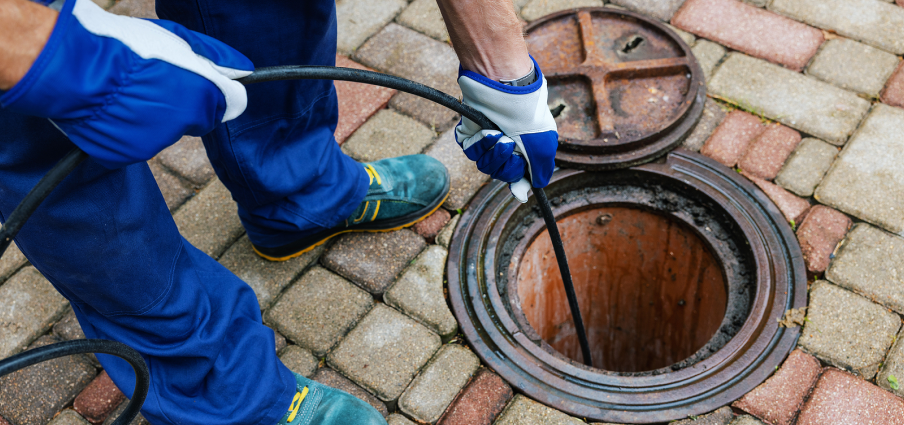
Cabling, also called snaking or augering, drives a rotating steel cable with a cutting head through the line. It is fast, it handles soft blockages and root intrusion well, and it is usually the right call in fragile older pipe where high pressure carries risk. The limitation is coverage: cabling bores a path through the obstruction rather than cleaning the full circumference of the wall.
Hydro-jetting
Hydro-jetting uses high-pressure water through a nozzle that directs jets forward and backward at once. The forward jets break the blockage. The rear jets pull the hose through and scour the pipe wall clean, flushing debris toward the main.
Mechanical cabling | Hydro-jetting | |
Best for | Soft clogs, roots, quick clearing | Grease, scale, sludge, full-diameter cleaning |
Result | Opens a channel | Restores close to original diameter |
Typical durability | Shorter, buildup remains on walls | Longer, walls are cleaned |
Pipe condition needed | Suitable for fragile lines | Requires a camera check on old or damaged pipe |
Common use | Reactive call-outs | Scheduled preventive maintenance |
Note: Hydro-jetting should never be booked blind on a building with unknown pipe condition. A camera inspection first protects both the line and the contractor, and it is the step low-cost operators skip.
When cleaning is not the answer
Cleaning restores flow. It does not fix pipe. If the camera shows a belly, an offset joint, a collapse, or corrosion holes, your options are spot repair, pipe lining, or replacement. A contractor recommending repeat jetting on a structurally failed line is selling a subscription to the same problem.
Set a Maintenance Interval Before the Signs Appear
Reactive drain work costs more than scheduled work, mostly because of when it happens. Emergency call-outs land during service hours, close washrooms and kitchens, and sometimes arrive with water damage attached.
The intervals below reflect common industry practice and should be adjusted to your own service history. Grease interceptors are the exception, since many municipalities enforce the 25% rule, which requires cleaning once accumulated grease and solids reach a quarter of the unit’s liquid depth.
Facility type | Suggested line cleaning interval | Camera inspection |
Full-service restaurant | Quarterly | Annually |
Cafe or limited food service | Twice per year | Every 2 years |
Multi-family residential | Annually, per stack | Every 2 to 3 years |
Office building | Annually | Every 3 years |
Retail and hospitality | Twice per year | Every 2 years |
Buildings 40+ years old, any type | Twice per year | Annually |
A short standing checklist for site teams:
- Log every slow drain, odor, and gurgle by fixture and date
- Refill unused floor drain traps monthly
- Post clear signage on what may not be flushed in public washrooms
- Fit and empty strainers in every kitchen and mop sink
- Keep an access map showing cleanout locations on each floor
- Escalate to inspection at three DIY treatments on one fixture in 90 days
Final Thoughts
Drain failures give notice before they cause damage. Slow water, odors, and gurgling are the early signals. Multiple clogged fixtures, backups into unused drains, failed DIY attempts, and abnormal toilet levels are the late ones, and they usually mean the main sewer line is involved. The dividing line is simple: one fixture affected and cleared for good is maintenance, while anything recurring or spreading is a line problem that needs a camera inspection before any cleaning method is chosen. Match the method to the pipe, cabling for fragile lines and roots, hydro-jetting for grease and scale, and repair when the camera shows structural damage. Then set an interval so the next blockage is caught on a schedule instead of during a lunch rush.
Cleaning 365 Services handles camera inspections, hydro-jetting, and scheduled drain maintenance for commercial and multi-unit properties. Book an inspection today and get the footage before the backup.
Frequently Asked Questions
How do I know if a clog is in the fixture or the main line?
Run water in a nearby fixture. If the problem stays with one drain, it is local. If a second fixture gurgles, drains slowly, or backs up, the blockage is in the shared line. Ground-floor fixtures showing symptoms first is a strong main line indicator.
Is hydro-jetting safe for older pipes?
It can be, provided a camera inspection is done first. Jetting is safe in structurally sound cast iron, PVC, and clay. It is not appropriate for pipe with cracks, holes, heavy corrosion, or separated joints. A contractor who jets without inspecting an old line is taking a risk with your building.
How long should professional drain cleaning last?
Cabling a grease line may hold for weeks to a few months, since buildup remains on the pipe wall. Hydro-jetting a line back to near-original diameter typically holds far longer. Durability depends on what goes down the drain, so a busy kitchen will always need shorter intervals than an office.
Can I keep using liquid drain cleaner between services?
Not in commercial systems. Repeated use degrades older pipe and gaskets, clears only the surface of a blockage, and leaves residue that is a hazard for the technician who opens the line.
Why do my drains smell when nothing is clogged?
Most often a dry trap. Water in the P-trap evaporates in rarely used floor drains and washrooms, and sewer gas passes through the empty seal. Refill the trap and wait. If the odor returns, the cause is organic buildup inside the line or a venting fault.
How often should commercial drains be professionally cleaned?
It depends on load, not calendar preference. Full-service kitchens generally need quarterly line cleaning, offices and low-traffic sites annually, and any building over 40 years old twice a year. Your own service history is the better guide once you have two cycles of records.
Should the whole building be cleaned or just the affected line?
That depends on what the camera shows. If one branch is fouled, clean the branch. If several stacks show the same buildup, or the building is over 40 years old with no service history, a full-system clean plus a baseline camera survey is the more economical route.