- Cleaning 365
The choice between hydro jetting and snaking depends on 3 things: what is in the pipe, how often it comes back, and what condition the pipe is in. Jetting cleans the wall and lasts longer. Snaking is faster and safer in damaged lines. A camera inspection decides which applies.
Two quotes land on your desk for the same blocked line. One is a same-day cable clear at a modest price. The other includes a camera survey and hydro jetting for several times the amount. Both contractors say the problem will be solved, and neither quote explains why the other approach is wrong.
This guide is written for facility managers, property managers, and maintenance leads who approve those quotes and want to judge them on something better than price. You will find what each method physically removes, where each one is the right call, a decision matrix by blockage type and property type, when pipe condition rules one out, and the questions to ask before signing. By the end you will be able to look at a symptom and a building and know which method belongs in the scope.
The Short Answer for Commercial Properties
For buildings with grease, heavy use, or a history of repeat blockages, hydro jetting is the better choice. It removes material from the full circumference of the pipe and restores flow capacity close to the original diameter. Snaking clears the immediate obstruction and leaves the coating that caused it.
One condition overrides that. If the pipe is cracked, corroded through, or holding separated joints, high-pressure water can worsen the damage. That is why a camera inspection belongs before any jetting decision, not after.
Info: The real comparison is not jetting against snaking. It is cost per month of clear flow. A cheaper visit that holds for 5 weeks is more expensive across a year than a larger visit that holds for 8 months.
Hydro Jetting vs Snaking at a Glance
Drain snaking | Hydro jetting | |
Tool | Rotating steel cable with a cutting or retrieval head | Hose and nozzle delivering water at 3,000 to 4,000 PSI |
What it removes | The obstruction it contacts | Grease, sludge, sediment, scale, roots, full wall coating |
Coverage | A channel through the blockage | Full pipe diameter |
Result | Flow restored at one point | Flow capacity restored along the run |
Typical durability | Shorter, buildup remains | Longer, wall is cleaned |
Speed on site | Fast | Slower, plus survey time |
Upfront cost | Lower | Higher |
Pre-work needed | Usually none | Camera inspection |
Pipe condition required | Suitable for fragile lines | Sound pipe only |
Best use | Isolated clogs, emergency relief | Grease, scale, recurring blockage, preventive cleaning |
How Drain Snaking Works
A drain auger, also called a plumbing snake or mechanical cable, is a flexible steel cable fed into the line and rotated by a drum machine. A head on the end cuts, breaks, or hooks whatever it meets. Longer sectional machines reach well into branch lines and mains.
What snaking removes well
Cable is good at contact work. It handles soft blockages, paper masses, dropped objects, and root intrusion, and root cutting is a job jetting alone often cannot finish.
Where snaking is the right call
- A single blocked toilet or fixture with no other symptoms
- An object recovered rather than pushed through
- Emergency relief when a floor needs to reopen in the next hour
- Older cast iron, clay, or corroded pipe where high pressure carries risk
- Root intrusion, usually as the cutting stage before a jetting pass
The limitation worth understanding
Cable bores a path. Picture a drainpipe lined with hardened grease and a cable driven through the middle of it. Water flows again, the call is closed, and 80 percent of the deposit is still sitting on the wall. The line then re-blocks at the same point, which is why recurring blockage at one fixture is the clearest sign that cable is being used where jetting is needed.
Note: Three cable clears at the same fixture inside a year is not three separate problems. It is one problem that has been billed three times.
How Hydro Jetting Works
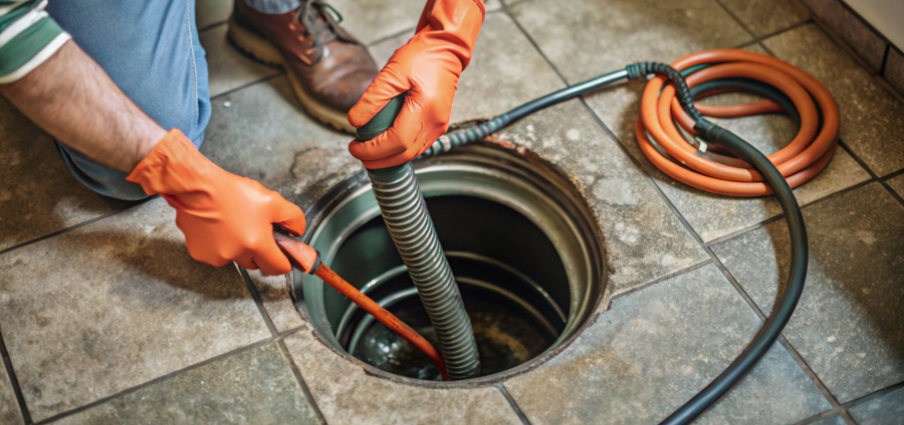
A hydro jetter pushes water through a specialised nozzle at high pressure. Forward jets break the blockage. Rear-facing jets propel the hose along the pipe and scour the wall behind it, flushing debris toward the main. The line ends up cleaned rather than merely opened.
What high-pressure water removes
Water at 3,000 to 4,000 PSI strips material that a cable slides past. Hardened fats, oils, and grease come off the wall. So do soap scum, food waste, sludge, sediment, and mineral scale in aging cast iron.
Grease is the reason most commercial kitchens end up on a jetting programme. The U.S. Environmental Protection Agency has long identified grease as a leading contributor to sanitary sewer overflows, and it enters lines warm, then cools and bonds to the wall during every service period.
Where hydro jetting is the right call
- Commercial kitchens, restaurants, hotels, and any site with FOG in the line
- Any line that has blocked more than twice in a year
- Scale buildup in older cast iron stacks
- Scheduled preventive cleaning where the goal is capacity, not just flow
- Grease interceptor discharge lines and kitchen floor drains
- Before a camera survey where the wall is too coated to assess
Why the camera inspection comes first
Jetting a line of unknown condition is the mistake that turns a cleaning job into a repair job. A camera survey shows pipe material, wall condition, and whether cracks, corrosion holes, or separated joints are present. It also shows what the blockage actually is, so the nozzle and pressure can be matched to it.
A contractor who quotes jetting on an old building without surveying it first is guessing, and the risk sits with your building. Ask for recorded footage with distance markers before and after the work.
Choosing Between Hydro Jetting and Snaking
Two questions settle most cases. What is in the pipe, and can the pipe take pressure.
Decide by what is blocking the line
What the camera shows | Recommended method | Why |
Hardened grease coating the wall | Hydro jetting | Cable passes through grease without removing it |
Mineral scale in cast iron | Hydro jetting | Restores lost diameter |
Sludge and sediment in flat runs | Hydro jetting | Flushes material out rather than compacting it |
Wipes and paper mass | Snaking, then jetting | Cable breaks the mass, water clears the residue |
Tree roots | Snaking to cut, then jetting to clear | Cutting head does what water cannot |
A dropped object | Snaking | Retrieval, not cleaning |
A single soft clog near the fixture | Snaking | Fastest resolution, no wall coating present |
A belly, offset joint, or collapse | Neither | Structural repair, cleaning will not hold |
Decide by property type
Property type | Usual primary method | Notes |
Restaurants and commercial kitchens | Hydro jetting | Grease load makes cable a short-term fix |
Hotels and hospitality | Hydro jetting | Kitchen grease plus hair and wipes in guest areas |
Healthcare facilities | Both | Wipes and gloves need cable, discharge lines need jetting |
Office buildings | Snaking, jetting on aging stacks | Paper blockages are localised, scale is not |
Retail properties | Snaking | Light load, isolated clogs |
Industrial facilities | Hydro jetting | Sediment and process residue settle across the run |
Multi-family residential | Both | Cable for roots in the lateral, jetting for grease in stacks |
Any building 40+ years old | Camera first, then decide | Pipe condition governs the choice |
Decide by pipe condition and age
Pipe material and condition can rule out jetting regardless of what is in the line. Sound PVC, healthy cast iron, and intact clay handle high pressure without trouble. Corroded cast iron with wall loss, cracked clay, and separated joints do not.
When neither method is the answer
Cleaning restores flow. It does not repair pipe. If the survey shows a settlement belly, an offset joint, a collapse, or corrosion holes, the correct scope is spot repair, pipe lining, or replacement. Repeat jetting on a structurally failed line produces a recurring invoice and no lasting improvement.
Info: Pipe condition is the one input that can reverse the general recommendation. Grease in a fragile line still needs removing, but the method becomes careful cable work and a repair plan, not pressure.
Cost – Why the Cheaper Visit Is Often the Expensive One
Snaking costs less per visit. That is the whole of its price advantage, and it holds only if the visit is a one-off.
Compare across a service year instead. A grease-loaded kitchen line cabled every 6 weeks generates roughly 8 call-outs, most of them during trading hours at emergency rates, with no inspection record produced. The same line jetted on a scheduled interval generates far fewer visits, each booked outside operating hours at a contract rate, each producing footage and a report.
What the cheaper option leaves out:
- Downtime during trading hours, which is usually the largest real cost
- No camera record, so no evidence to support changing the interval
- Buildup left on the wall, so the next blockage is already forming
- No documentation for compliance or insurance purposes
Our guide on how often to clean commercial drains covers the intervals that make a scheduled programme work.
Using Both Methods Together – Hydro Jetting Vs. Snaking
Framing the decision as one method against the other misses how the work is often done. On a heavily blocked commercial line, a sensible sequence uses both.
- Cable first to open a path and get flow moving, which stops the immediate disruption
- Camera survey the opened line to see wall condition and confirm what is there
- Hydro jet to strip the remaining coating and restore capacity
- Camera again to record the finished condition as a baseline
- Set an interval based on what came out and what the footage shows
Root intrusion follows the same pattern for a different reason. The cutting head severs the root mass, and the jetting pass flushes the debris and cleans the joint so regrowth is easier to spot next time.
What Each Method Needs From Your Site
Scope arguments often come down to access rather than technique. Confirm these before the crew arrives, because a method that suits your pipe is still the wrong choice if the site cannot support it.
Requirement | Drain snaking | Hydro jetting |
Access point | Cleanout or removed fixture | Cleanout, ideally external |
Water supply on site | Not needed | Needed to feed the jetter |
Space for equipment | Small drum machine | Trailer or skid unit, vehicle access |
Downtime window | Often under an hour | Half day or longer per run |
Containment | Minimal | Splash and debris control at the access point |
Noise | Moderate | Higher, plan for out-of-hours work |
Buildings with no external cleanout are the common sticking point. Crews then have to work through a pulled fixture or a roof vent, which adds time and limits which nozzles can be used. Fitting a proper cleanout during a repair is minor work and makes every future visit faster and cheaper.
Note: Ask whether the quoted price assumes access that your building actually has. A jetting quote priced on external cleanout access will change once the crew finds there is none.
Questions to Ask Before You Approve the Quote
A quote that answers these is a scope. One that does not is a guess with a price on it.
- What does the camera footage show, and can I have a copy?
- What is the pipe material and its condition along this run?
- Which method are you proposing, and what made you choose it?
- What pressure and nozzle will be used, and is the pipe rated for it?
- Will I get before and after footage with distance markers?
- If this line has blocked before, what changes this time?
- Are you finding a cleaning problem or a structural one?
- What interval do you recommend, and what is that based on?
Note: A contractor who only ever proposes one method across every building is scheduling around their equipment rather than your pipe. Both tools have a correct use.
Final Thoughts
Hydro jetting cleans the full pipe wall at 3,000 to 4,000 PSI and holds far longer. Snaking bores a channel through one obstruction and leaves the coating that caused it. For commercial kitchens, hotels, industrial sites, and any line that has blocked more than twice in a year, jetting is the method that ends the cycle. Cable still has clear uses: isolated clogs, dropped objects, same-hour emergency relief, root cutting, and fragile pipe that cannot take pressure. Pipe condition overrides everything else, which is why a camera inspection belongs before the decision rather than after it. If the footage shows a belly, an offset joint, or corrosion holes, no cleaning method will hold and the scope is repair.
Cleaning 365 Services surveys the line first, then recommends the method your pipe can take. Book a camera inspection and get a scope built on footage, not guesswork.
Frequently Asked Questions
Is hydro jetting better than snaking?
For grease, scale, sludge, and recurring blockages in commercial lines, yes. Jetting removes material from the full pipe diameter while cable clears a channel through it. Snaking is still better for isolated clogs, object retrieval, root cutting, and pipe too fragile for high pressure.
Can hydro jetting damage pipes?
It can, in pipe that is already failing. Corroded cast iron with wall loss, cracked clay, and separated joints are at risk. Sound PVC, healthy cast iron, and intact clay handle it without trouble. A camera inspection before the work is what separates the two cases.
Why does my drain keep blocking after being snaked?
Because the buildup was never removed. Cable opens a path through the deposit and leaves the rest on the pipe wall, so the opening narrows again from the same starting point. Repeat blockage at one fixture points to a coating that needs jetting.
Do I need a camera inspection every time?
Not for a simple fixture clog cleared by cable. Yes before any jetting on a line of unknown condition, on any building over 40 years old, and on any line that has blocked repeatedly. Ask for footage after the work as well, since it gives you a baseline.
How long does hydro jetting last compared with snaking?
Jetting holds longer because the wall is cleaned rather than pierced, though the interval still depends on what enters the drain. A busy kitchen will always need shorter intervals than an office regardless of method.
Which method is used for tree roots?
Usually both. A cutting head on the cable severs the root mass, and a jetting pass then flushes the debris and cleans the joint. Roots regrow, so lines with intrusion need repeat service or a repair to the joint letting them in.